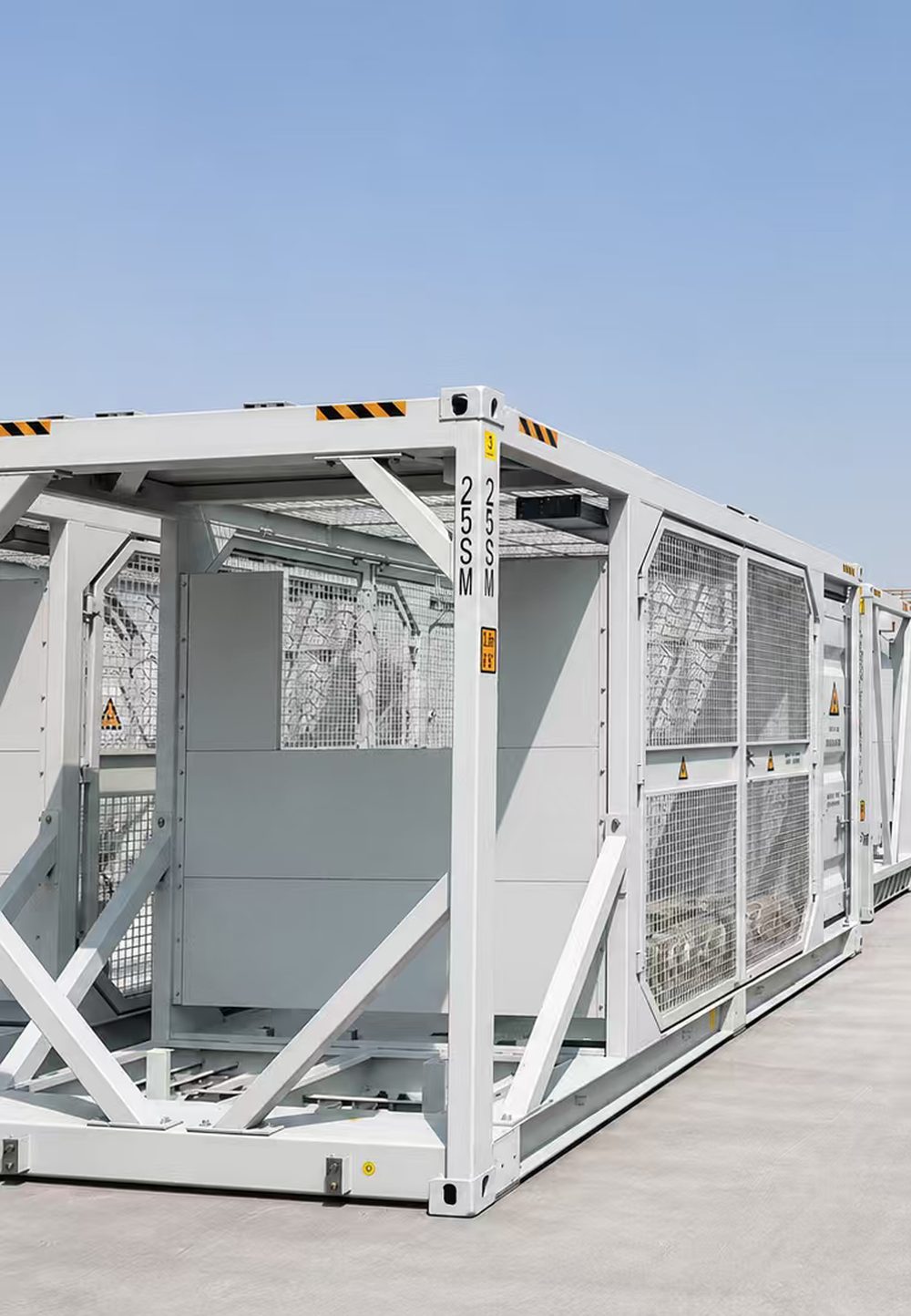
The substation travels with the site. A skid or a container can be dismantled, reloaded and reinstalled elsewhere. That matters for temporary power, a construction base, a provisional extension, or an asset that must be removable at end of life.
Transformer, MV switchgear and LV board assembled on a steel frame or inside a transportable enclosure, wired and tested in the factory. On site: set it down, connect, energise.
On a conventional substation the transformer, the MV switchgear and the LV board arrive separately and are married on site. Every interface is then a risk: a dimension that does not land, a busbar to rework, a fault that only shows at energisation, with a different contractor responsible for each package. An integrated unit moves that work into the factory. Everything is assembled, wired and tested as one before shipment, then delivered as a single object under a single responsibility, ours.
The gain shows up on site. There is no heavy slab to pour and no building to erect; the unit is craned onto a prepared bearing surface. The time between delivery and energisation is counted in days rather than weeks. And where a project involves several identical substations, a solar farm or a site built in phases, the second unit is an exact copy of the first, which a substation built in place never guarantees.
This format has taken hold wherever power arrives before buildings do. Battery storage projects and solar and wind farms use it as a step-up substation, close to the inverters or the machines. Data centers use it to deliver capacity in phases without committing a permanent room at every step. High-power EV charging hubs get a complete substation on a small footprint. Industrial sites, quarries, ports and construction bases value being able to power a zone without committing to a building.
If your substation is meant to stay put and to mark the boundary with the public network, look at the prefabricated MV substation instead. Above 36 kV, see the engineered HV substation.
The choice comes down to three questions: does anyone need to walk inside, does the unit need to move, and what rating must it carry.
| Criterion | Open skid | Containerised | E-house |
|---|---|---|---|
| Principle | welded steel frame, equipment mounted on top | closed enclosure, ISO container or bespoke | prefabricated electrical building, walk-in |
| Operator access | from outside | service doors, no aisle | internal operating aisle |
| Usual rating | up to ≈ 2,000 kVA | up to ≈ 2,500 kVA | several MVA, several bays |
| Transport | lifting lugs, lashed on a flatbed | ISO corner castings, standard handling | modules, abnormal load possible |
| Civil works | level bearing, ground beams | level bearing or pads | designed slab |
| Climate control | not applicable | natural or forced ventilation | ventilation, heating or air conditioning |
| Natural ground | BESS, solar, construction | data center, EV charging, industry, ports | process industry, high rating |
Indicative values. Real limits depend on voltage level, cooling method and the transport constraints to your site, confirmed at quotation and validated with the factory.
| MV voltage | up to ~36 kV; 15 / 20 kV common in France |
|---|---|
| LV voltage | 400 / 230 V · 50 Hz (other voltages on request) |
| Rating | 250 kVA to several MVA depending on the format |
| Transformer | Cast resin (dry-type) or oil / ester immersed with bund |
| MV switchgear | SF6-insulated or solid-insulated cubicles, per site requirement |
| LV board | Integrated main board, outgoing ways and metering as required |
| Enclosure | Steel skid, 20 ft / 40 ft ISO container, or bespoke enclosure |
| Protection | IP and IK per site exposure, corrosion protection matched to the environment |
| Handling | Lifting lugs, fork pockets or ISO corner castings by format |
| Standards | IEC 62271-202 (prefabricated substation) · IEC 62271-200 (MV switchgear) · IEC 60076 (transformer) · IEC 61439-2 (LV assembly, design verification) · NF C 13-100 where it is a delivery substation |
| Switchgear classes | Service continuity LSC2A or LSC2B, PM partitioning, internal-arc classification IAC AFLR, kA/s value fixed at quotation |
| Testing | Routine tests on the transformer, tests on the assembled unit, witnessed FAT available |
| Delivered lead time | 16 to 20 weeks, manufacture + transport (confirmed at quotation) |
Medium-voltage switchgear usually drives the lead time, ahead of the transformer. If your operator mandates a switchgear brand, say so at enquiry stage.
Two units of identical rating can carry very different functions. These four options combine freely; name the ones that apply at enquiry stage, since they often weigh more on price and lead time than the rating itself.
| Option | What the unit carries in addition | When it makes sense |
|---|---|---|
| Measurement and control | Power-quality meter, temperature monitoring, local alarm reporting | Common baseline, present on every configuration |
| Remote-management terminal | Communication gateway, remote access to readings and alarms | Unmanned site, distributed fleet, remote operation |
| Integrated conversion (PCS) | Bidirectional inverter housed in the same unit as the transformation | Battery storage, solar coupling, grid injection |
| Separate DC-DC room | Dedicated compartment for DC-DC converters, testing included | DC-bus storage architectures |
The unit can also take two transformers in one enclosure, or withdrawable LV ways in place of fixed outgoing ways. These choices change footprint and transport: settle them before manufacturing starts.
Placed on the EU market under our own brand, the unit ships with CE marking, EU Declaration of Conformity and full technical documentation. Conformity of the transformer (Ecodesign Tier 2, IEC 60076), of the medium-voltage switchgear (IEC 62271-200), of the low-voltage assembly (IEC 61439) and of the prefabricated substation as a whole (IEC 62271-202) is our responsibility as manufacturer. Where the unit marks the boundary with the public network, the design follows NF C 13-100 and the distributor's requirements; exact clause applicability is confirmed with the DSO and the factory.
One point deserves early attention: transport and lifting constraints. Total mass, sling points, road envelope and crane access at the setting-down point drive the format as much as the rating does. We fix them during the study, with general arrangement drawings and a lifting note.
A concrete prefabricated substation sits on a slab and stays there. A skid is a welded steel frame designed to be lifted, transported and set down again: it moves with the site. A skid needs less civil work but imposes lifting and lashing constraints. We supply both.
Yes, and that is the main point of an integrated unit: transformer, MV switchgear and LV board are wired and then tested together in the factory, with routine tests on the transformer and tests on the assembled unit. Factory acceptance tests can be witnessed, on site or remotely. See our test protocol.
Yes for most configurations up to roughly 2,500 kVA, in 20 ft or 40 ft. Above that, or where an internal operating aisle is needed, the unit moves to a non-standard enclosure or an e-house. An ISO container markedly simplifies transport, lashing and port handling.
Allow 16 to 20 weeks delivered to site. The medium-voltage switchgear usually drives it, not the transformer: if your operator mandates a switchgear brand, say so at enquiry stage. The exact date is confirmed at quotation.
That is its natural ground. Solar farms, wind farms and battery storage projects commonly use skid-mounted or containerised step-up substations: they install quickly, repeat identically from one unit to the next, and can be removed at end of life.
An e-house is a larger prefabricated electrical building that an operator can walk into: an operating aisle, lighting, ventilation or air conditioning, sometimes several bays. It is chosen when operation requires internal access, or when the rating exceeds what a compact enclosure allows.
Rating, enclosure format, switchgear, lifting constraints: describe the need and we answer within 48 h.
Configure a quote →